
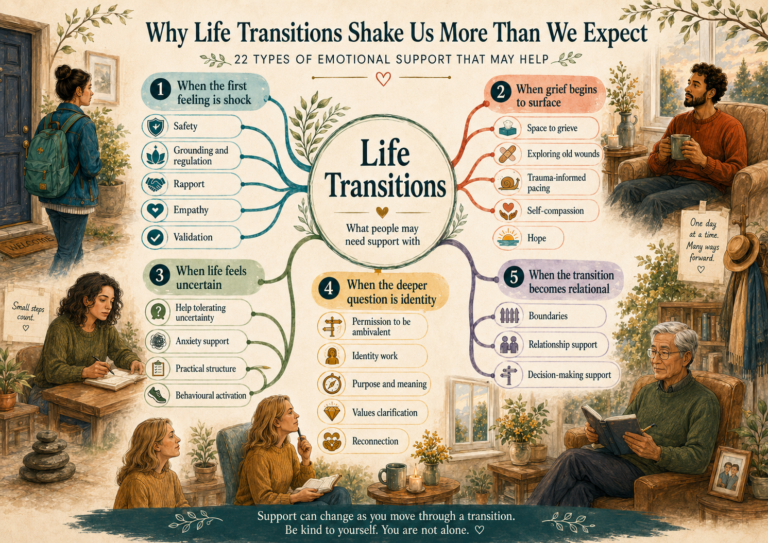
22 Types of Emotional Support That May Help
Sometimes the event itself is only the beginning.
The relationship ends. The diagnosis arrives. The children leave home. The job disappears. A parent dies. At first, we think we are responding to what has happened. But often, something larger begins to stir.
We may find ourselves asking questions that seem bigger than the event: Why do I feel so shaken? Who am I now? Why does this feel familiar? What am I supposed to do with the life that remains?
This is the hidden work of transition. It is not only the practical adjustment to change, but the emotional and psychological reorganisation that follows.
Life is rich with change. We go to school, leave home, move in and out of relationships, marry, divorce, have children, watch them leave home, lose people close to us, find jobs, leave jobs, relocate, receive diagnoses, have accidents.
Some changes are expected and orderly. Others happen brutally, out of the blue. All of them change us. Some leave us shaken and unsure of the path ahead.
Psychologist Erik Erikson famously proposed that there are eight life stages: psychological turning points through which we continue to develop across the lifespan. We are repeatedly asked to adapt and develop capacities such as trust, independence, identity, intimacy, contribution and, eventually, the ability to make meaning of the life we have lived.
Major life transitions can unsettle these capacities, which is why a change in circumstance can also become a crisis of confidence, belonging, purpose or meaning.
At 57, I’ve lived through six of these stages. But in reality, we may revisit these “crises” throughout life, depending on what happens to us. Divorce after a decade of marriage may reopen questions of identity: Who am I outside this relationship? What role fits me now? The same can happen when children leave home.
I have come to think of transitions as unfolding in layers. At first, we may need to be steadied. Later, we may need to grieve, process and make sense of what has happened. Then we may need practical support to live with uncertainty. Eventually, deeper questions of identity, purpose and relationships may come into view.
So perhaps the question is not only, What kind of therapy do I need? but, What kind of support is this transition asking for?
1. When the first feeling is shock
Safety | grounding and regulation | rapport | empathy | validation
When we’re going through something sudden and traumatic, like bereavement, a diagnosis, sudden job loss, betrayal or an accident, it can be overwhelming and destabilising. Our whole being can go into shock.
Before we can analyse, decide or make meaning, we may simply need to be steadied.
It’s the company of another human being that can give us the space to be held, heard and safe. Whether we just want to breathe, speak, cry or get through the next hour, we need someone who can listen without trying to fix the situation.
We want to know that what we are saying makes sense for what we are going through. This validates our experience.
The presence of another person’s calm nervous system can have a profound impact on ours; imagine a baby settling in a parent’s arms. It also helps to receive empathy, not just sympathy: someone who does not only feel sorry for us, but tries to put themselves in our shoes and authentically be there.
It may be that we do not have the right person in our lives to reach for in these moments. If so, there are people we may not know personally who can help: therapists, helplines and volunteers at organisations such as Cruse for bereavement or Relate for relationship issues.
2. When grief begins to surface
Space to grieve | exploring old wounds | trauma-informed pacing | self-compassion | hope
Once there is a little more steadiness, grief may begin to appear.
It may be grief for a person, a relationship, a body, a future, a home, a job, a role, or a version of ourselves. Even wanted changes can involve loss: moving out of the family home, finishing university, ending a relationship or starting a new job.
Talking about what has happened can help us digest and make sense of it. It can take repetition, tenderness and time. Each time we tell the story, feel the feelings and survive the telling, the event may become a little less overwhelming. Slowly and gently, we may begin to live alongside it rather than being consumed by it.
Sometimes we get stuck, and the difficult event may become traumatic. Different therapy approaches work with trauma in different ways, but a common aim is to help the brain and body process the event so that it no longer feels as if it is happening all over again.
Transitions can also reactivate old wounds because they unsettle the structures that usually help us feel secure. A present loss, rejection or change of role may touch earlier experiences of abandonment, shame, helplessness or grief.
This does not mean the old wound has to be dealt with immediately. First, the person may need to be steadied in the present. Only when there is enough safety can we begin to notice what has been reawakened from the past.
It is a paradox that while life is ever-changing, many of us struggle to cope with change. We need to treat ourselves with compassion and soften the voice that tells us we should be coping better.
Speaking to others in a similar situation, or who have come through something similar, can also help. It can make us feel less alone and bring much-needed hope: a guiding light that it is possible to feel better.
3. When life feels uncertain
Help tolerating uncertainty | anxiety support | practical structure | behavioural activation
Not all transitions arrive as a single shock. Some unfold over weeks, months or even years.
Perhaps you’re waiting for test results, adjusting to a new role, looking for work, recovering from burnout, or living in that uncomfortable in-between place where the old life has gone but the new one has not yet formed.
Uncertainty can be exhausting. The mind often tries to protect us by racing ahead, imagining every possible outcome. We may overthink, catastrophise, seek reassurance, avoid decisions or feel paralysed by the number of unknowns.
At other times, uncertainty tips us into shutdown. We may feel flat, numb, withdrawn or unable to begin.
At this point, therapy may need to become quite practical. This does not mean ignoring the emotional depth of what is happening. It means recognising that when life feels chaotic, small structures can help us feel more anchored.
This might include regular sleep and meals, manageable plans, grounding techniques, small decisions, and noticing what is within our control and what is not. For low mood, we may need gentle behavioural activation: small steps back towards movement, connection, pleasure and meaning.
Behavioural activation is not about forcing ourselves to “cheer up”. It is about recognising that when we feel low, we often withdraw from the very things that might slowly help us feel more alive again. The steps may need to be tiny: getting dressed, stepping outside, replying to one message, making a meal, walking around the block.
During uncertain times, we may not be able to solve everything. But we can often find the next small, kind, possible thing.
4. When the deeper question is identity
Permission to be ambivalent | identity work | purpose and meaning | values clarification | reconnection
Then, often quietly, comes the deeper question: Who am I now?
Some transitions make us examine who we are becoming. When children leave for university, a parent may feel a void when they are no longer needed to organise, care for, or structure daily life around their dependents. They may be proud of their child’s independence and still feel destabilised by the sudden quiet.
When a role that once gave shape to our days changes, we can feel empty and directionless. The routines that held us, the tasks that gave us purpose, and the people who needed us in familiar ways may no longer be there in the same form.
The mixed feelings may include the loss of our former self, sadness for the past we didn’t quite fulfil to its potential, fear of time slipping by, or panic that we may not have achieved enough. A transition can make us aware not only of what is changing now, but of what has already passed.
In therapy, this can become a space to ask: What will I do with my life moving forwards? How can I feel okay about not having lived my “best life”? How can I accept what has happened, without pretending it did not hurt or matter?
Taking time to discover our core values can help us align the direction of our life with a more meaningful path. When we feel empty or directionless, values can act like a compass. They may not give us an immediate answer, but they can help us notice what still matters and what kind of life we want to move towards.
Sometimes, changing roles can mean reconnecting with parts of ourselves once abandoned or never fully explored: friendships left unnurtured, nature unexplored, creative activities put to one side, or quieter longings we have not had time to listen to.
A transition may take something from us, but it can also bring us into closer contact with what feels true, meaningful and authentic now.
5. When the transition becomes relational
Boundaries | relationship support | decision-making support
At some point, transitions become relational. They begin to affect not only how we see ourselves, but how we relate to the people around us.
When we move into a new role, change our way of life, or begin making different choices, others may not know what is needed from them. They may still be responding to the version of us they knew before.
Family dynamics may change. Old routines may no longer work. New traditions, boundaries and roles may need to be established. This can take time, and the support of a neutral other can be enormously helpful.
For example, someone leaving a long relationship may be judged harshly, especially if their choices cause disruption or do not fit other people’s expectations. Yet beneath the behaviour there may be loneliness, unmet needs, longing, guilt, fear and confusion. They may know they could have handled things differently, while also needing to feel heard and understood as a normal human being trying to find their way through a painful transition.
This is where therapy can offer something rare: a space without judgement, but not without reflection. It is not about excusing every choice or pretending there are no consequences. It is about slowing things down enough to understand what happened, what belongs to us, what belongs to others, and how to move forward with more honesty and care.
During transitions, we may need help with boundaries: what we can offer, what we can no longer carry, and what we need to say no to. We may need relationship support because other people are adjusting too. And we may need help with decisions, especially when fear, guilt, obligation, desire and intuition become tangled together.
Sometimes the work of transition is not only becoming someone new. It is allowing the relationships around us to change shape too.
What kind of support do you need now?
You may not need all twenty-two of these things. You may need only one or two. And what you need may change as the transition unfolds.
At first, you may need to be steadied. Later, you may need to grieve. Then perhaps you need structure, courage, boundaries, meaning, or help imagining what comes next.
The therapy you need during a transition may not be one particular modality. It may be a relationship in which the right kind of support can emerge at the right time.
Because transitions are not just about adapting to change. They are about being accompanied as we make sense of what has ended, what has been stirred, and who we are becoming